- Hater's Guide to Living Well
- Posts
- Is this rulebook flattering on me?
Is this rulebook flattering on me?
Some guardrails on my buying habits with chic results.

Sarah Steimer
March 10, 2026
Since January 1, I have purchased the following items for my wardrobe:
new pair of white slip-on Vans
concert T-shirt at a Peaches show
oversized white button-up (second hand)
gold lamé clutch (second hand)
hand-knitted halter top (commissioned!)
red dress (second hand)
fuchsia belt (second hand)
I made myself a deal at the start of the new year: I would only buy 12 new clothing items in 2026, and an unlimited number of second-hand pieces. Eschewing online shopping wasn’t enough; I needed to do a better job with what I already own. So I spent two days cataloging my entire closet in an app (I use Indyx), and I’ve never had more fun putting together my little outfits. I twirl through a shopping montage in my closet each time I get ready to leave the house (not including dog walks — those will remain largely unstyled and frumpy because I like to look unapproachably dour at 7 a.m.).
I wrote previously about how the ease of shopping flattened the thrill of fashion, and creating some guardrails around my own buying habits has made it a decidedly creative endeavor. I realize I talk a lot about being chaotic, but there are absolutely parts of me that love a rule. This includes the part of me that feels strongly about staying to the right on sidewalks, or sticking to a precise morning routine to feel some semblance of control over my day.
Marc Fischli, executive managing director of advertising company Criteo, told Fast Company that online shopping has become a functional necessity that has been optimized for speed (one-click to buy!) while stripped of surprise and spontaneity.
“Today, we no longer ‘go shopping’—we are always shopping—but that hasn’t made the experience more exciting,” Fischli said.
How sad! Trying things on, touching fabric, actually seeing what color an item is in person — it all encourages a far more conscious consumption, because we’re right there with it. And for me, I can quite literally weigh whether the purchase will be worthwhile. Holding a garment and actively considering whether it has a place in my closet, versus seeing a styled model wearing the item, makes a pretty enormous difference.
I reached out to Hallie Borden, owner of Milk Handmade here in Chicago, via email for her take on IRL shopping. Milk is one of my favorite local shops: I’ve run across pieces I never would have thought to seek out, and that have gone into regular rotation in my closet.
“I do think that adding friction to the process of buying clothes is a good thing, in terms of discouraging over-consumption,” Borden told me. “There's an obvious benefit to selecting your clothes in person and trying them on before you buy them. I think the process encourages you to think of clothing as permanent, rather than something to wear a few times and throw in the ‘donation bin’ (which ends up in a landfill most of the time).”
She also brought up tailoring, noting that it is another point of friction, but she really encourages people do it: “A garment that fits perfectly is always going to be in fashion.”
I actually asked Borden for her alterations recommendation, and just this past week had two items hemmed that I am so excited to actually wear more often. Did I make a very big deal of having to add “go to the cleaners” to my to-do list? Yes, of course I did — even though that $40 errand was a drop in my time and effort bucket. One of those two items was a jumpsuit I bought online three years ago — something I realistically never would have purchased had I actually tried it on in person. These companies are not making clothing for 5-foot-1-inch women.
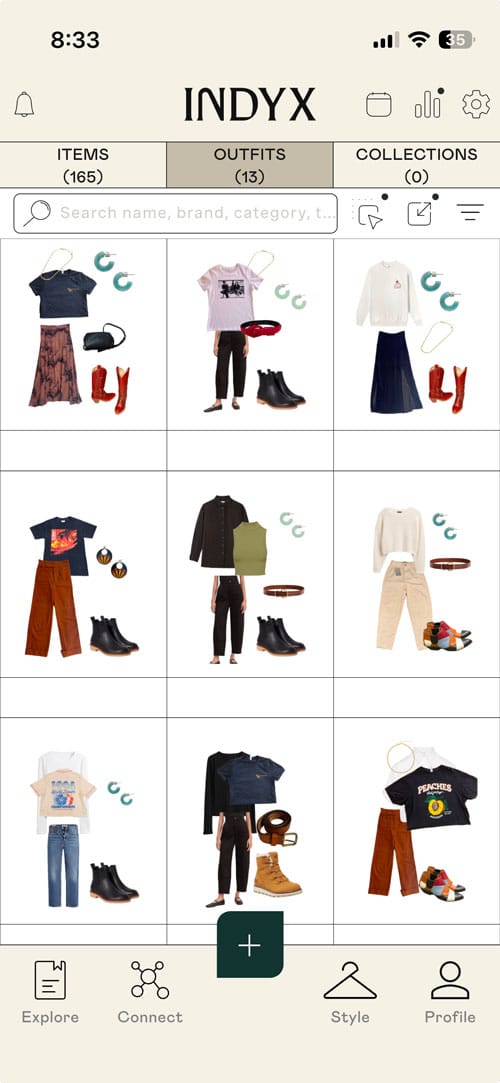
Just a little sampler of my outfits since I began tracking them. This brings me more serenity than meditating.
It’s helpful to remember that clothing brands are doing very little to offer sizes for real people. The Pudding published a story on women’s sizing last month, and the visual aids they provide are astounding.
“There are no regulations or universal sizing standards,” they write. “Instead each brand is incentivized to make up its own. When size guides change — and they’re always changing — brands are not obligated to disclose updates.”
So if the companies are not going to play by any one rulebook, other than its singular focus of making sure we buy moremoreMORE, we are obligated to create our own policies and principles.
“I’ve always loved fashion, but the part that never made sense to me was how much energy goes into buying clothes versus actually using them,” Indyx co-founder Devon Rule said in a Creative Currency interview. “We shop for items but live life in outfits, and there’s nothing out there helping us bridge that gap.”
My decision to buy fewer new items, and definitely not through the frictionless experience of online shopping, is definitely a screw-you to the global clothing industry. This sector is the second-biggest consumer of water, and 85% of all textiles go to the dump each year. There’s also the microplastics emitted by washing some of the garments, plus all the human rights violations in fast fashion. MUCH to hate.
But I really never started into this whole new plan focused on being more eco-conscious or anti-corporate greed. Those have actually just been happy little byproducts. I really did this because I wanted to get more creative with my closet, and there is research that shows creativity can benefit from imposing artificial restrictions.
It’s worked; you can call me Donatella Steimer now.
Reply